MIAM certificate · England and Wales
MIAM certificate: prepare with Miam
A MIAM certificate is the confirmation an authorised family mediator signs to show you attended a mediation information and assessment meeting (MIAM), which most family court applications must include[1][2]. It comes with the MIAM at no extra charge[3] and covers an application made within 4 months[4]. Miam is a free AI assistant that helps you prepare.
Beta Beta service. Always check with official government websites.
Last reviewed Sources checked
01/ Start here
Plain-English guides
Who needs one, what happens and what it costs.
MIAM certificate costWhat you pay, and when the MIAM is free.
MIAM certificate expiry checkerThe last day your MIAM counts.
MIAM exemptionsThe situations the rules list.
C100 formApplying to court about children.
Form FM1The stand-alone MIAM form.
Find a mediatorThe FMC register, by postcode.
Child maintenance calculatorAn estimate using the CMS rates.
02/ What it is
What a MIAM certificate is
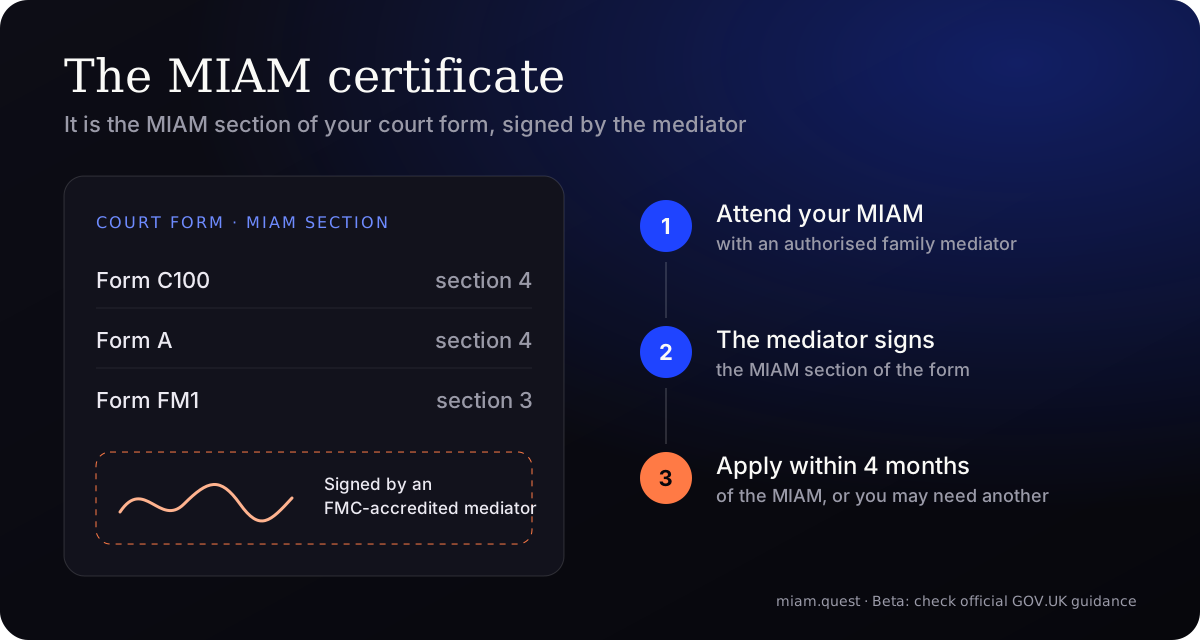
Before most applications to the family court about children or money you must attend a MIAM: a mediation information and assessment meeting[8][9]. Your application then has to contain either confirmation from an authorised family mediator that you attended, or an exemption you are claiming[1]. The Family Mediation Council calls that confirmation the mediator's certificate, or MIAM certificate[10].
It is not a separate document: it is a section of the court form that the mediator completes, dates and signs, with their Family Mediation Council registration number[11]. The form depends on what you are applying for: Form FM1 goes with a Form C1 or C2, while the C100 and Form A carry their own MIAM sections[12].
03/ What Miam does
Miam prepares you. The mediator signs your MIAM certificate.
Miam is a free AI assistant: our "AI for Good" project, with nothing to pay. Talk or type it through: what you want for the children, what you could agree, what worries you and what to ask. You walk into the MIAM with what Miam helped you write down.
Only an authorised family mediator can conduct a MIAM and sign the confirmation the court needs[2]. Miam cannot run a MIAM, sign a MIAM certificate, decide whether an exemption applies or give legal advice.
05/ Getting one
How to get a MIAM certificate
Open any step to read the detail, from first contact to a signed form.
06/ Who signs it
Who can sign a MIAM certificate
Only an authorised family mediator, a person the Family Mediation Council identifies as qualified, can conduct a MIAM and sign the confirmation[2]. The FMC says only mediators it has accredited, known as "FMCA", can sign a court form to say you have been to a MIAM[36], and only once the MIAM has taken place[37].
So not every mediator can sign: some mediators on the register are still working towards accreditation, and only accredited (FMCA) mediators are recognised as qualified to sign the MIAM section of court forms[38][39]. When you search the FMC register, tick the filter for mediators qualified to sign court forms[27]. See find a mediator or MIAM near me.
07/ What it says
What your MIAM certificate confirms
On the C100, the mediator ticks whether only you attended a MIAM or each of you attended a separate one[11]. They also tick why mediation or another non-court option is not going ahead: for example, you do not consider it appropriate, the mediator has said it is unsuitable at this time, or the other parent has not attended a MIAM[11].
It does not tell the court what was said: mediators must not share information from a MIAM, and if mediation is not going ahead the only reason they give the other person or the court is that it is not suitable at the present time[40].
08/ How long it lasts
How long a MIAM certificate lasts
If you attended a MIAM in the 4 months before your application, you do not have to attend another[4]. The rule applies to the same, or substantially the same, dispute[42].
The FMC's guidance for mediators puts it the same way: a mediator's signature on the court form is treated as valid for 4 months[37]. The FMC tells parents they can ask the mediator to sign the court form as long as the MIAM was within the last 4 months[33].
Use the MIAM certificate expiry checker to see the last day your MIAM counts.
Plan the date. If you expect to apply to court, book the MIAM when you are ready to apply within 4 months, not months ahead[4].
If your MIAM certificate has expired
Once the four months have passed, the exemption for a recent MIAM no longer applies[4]. The FMC's guidance says that if no mediation has taken place in that time, another MIAM should be held to check whether circumstances have substantially changed, and it may be shorter, with the fee adjusted[37]. Ask your mediator what they offer.
09/ What it costs
What a MIAM certificate costs
The MIAM typically costs £120–£150 per person, and each of you pays for your own[5]. There is no separate charge for the mediator completing the court confirmation: it is part of the MIAM[3].
The MIAM is free if either of you qualifies for legal aid; if only one of you does, legal aid covers the MIAM and the first mediation session for both[43]. For disputes about children, the Family Mediation Voucher Scheme can pay up to £500 towards mediation sessions after the MIAM, but not the MIAM itself[44][45]. More on MIAM certificate cost.
If you then apply to court, the court fee comes on top[46]. Pick an application below to see what it costs:
10/ Exemptions
MIAM exemption certificate: when you may not need a MIAM
There is no "exemption certificate": to claim an exemption, you tick the exemption boxes on the court form[14], and where an exemption needs evidence you send it with the application[51]. GOV.UK says you will not usually need a MIAM if[52]:
- you went to a MIAM, or tried other ways of agreeing, in the last 4 months[52];
- you have evidence that you are a victim of domestic abuse, in one of the forms the rules list[52][24];
- you are applying for a consent order[52];
- your children are at risk of harm, for example social services are involved[52][53];
- you cannot attend because of your location, situation or the mediator's availability[52][54];
- you are applying for a without notice hearing, or the application is urgent[52][55].
The court decides whether an exemption is valid, and it can direct you to attend a MIAM if it is not[26]. See MIAM exemptions, and if you are not safe, domestic abuse support.
11/ If they will not come
Your MIAM certificate if the other parent will not attend
You can still get your confirmation and apply to court if you attend a MIAM and the other parent does not[7][52]. One of the reasons the mediator can tick on the C100 is that the other parent has not attended a MIAM[11].
Practice Direction 3A expects the other parent to attend a MIAM, with you or separately, and you should give the mediator their contact details so they can be invited; if they are unwilling, you should still attend[22]. It does not force them to go: the FMC reports that about a third of potential mediation cases cannot go ahead because the second person chooses not to attend[56].
If the mediator contacts them and they do not reply or say no, the mediator may tell you, if it is safe, but any reason they give stays confidential[57]. If you do not want the other parent contacted, for example for safety reasons, tell the mediator: they should not put pressure on you[57].
If you are the parent who received the court papers
If the other parent has applied to court, the judge will expect you to have attended a MIAM too, unless the same specific circumstances apply[23]. If you later make a C100 application and rely on a MIAM you attended as the respondent in earlier proceedings, the form asks for its date and the mediator's name and contact details[58].
12/ Online
Getting a MIAM certificate online
You can have your MIAM by video: the FMC's standards allow MIAMs in person or by video, and by telephone only when there is no other option[31]. A video MIAM needs extra safeguards, such as confirming you are somewhere private and will not be disturbed[59]. The confirmation is the same: an accredited mediator signs it after the MIAM[37]. See online MIAMs.
13/ Lost or unsigned
If you have lost your MIAM certificate
Because the confirmation is a section of the court form, not a separate document, the fix is to go back to the mediator who ran your MIAM[58][33]. The C100 says you must ask that mediator to complete and sign section 4[11], and the FMC says you can ask for the court form to be signed as long as the MIAM was within the last 4 months[33].
If more than 4 months have passed, you may need a new MIAM instead[4].
14/ Get ready
Before your MIAM: a checklist
Tick things off as you go. Miam can help you work through the last two.
15/ Calculator
Estimate child maintenance
An estimate using the rates the Child Maintenance Service applies to the paying parent's gross weekly income, adjusted for shared care[62][63]. Use the full calculator for other children at home, benefits and more than one family.
16/ If you are not safe
If you are not safe
Domestic abuse, with evidence in one of the forms the rules list, is one of the situations in which a MIAM exemption can be claimed[24]; the court decides whether it applies[26]. A victim of domestic abuse can also apply for a non-molestation or occupation order[64].
If you tell Miam about abuse, it gives you the support lines and the exemption, and does not save what you said to your record. See domestic abuse support and the numbers below.
17/ How we check
Every figure has a source
Our guides each list the official sources they rely on, such as legislation, the Family Procedure Rules, HMCTS forms, GOV.UK, Cafcass and the Family Mediation Council, with the date we last checked them. We take court fees from the fees order itself, not from secondary pages.
Beta service. Always check with official government websites, and tell us if we have got something wrong.
18/ The MIAM form
Is there a separate MIAM certificate form?
For most people, no: the C100 and Form A each carry their own MIAM sections, so the mediator signs the application form itself[16][14]. The C100's opening pages also ask you to sign that you understand the court cannot process the application without a MIAM or a valid exemption, but returning that page is optional[58].
19/ Form FM1
Form FM1 and the MIAM certificate
Form FM1 is the stand-alone MIAM form[12]. HMCTS says it confirms whether you attended a MIAM or why not, and it goes with an application on Form C1 or C2[65]. You complete section 1, claim any exemption in section 2, and the mediator completes and signs section 3 with their FMC registration number[15]. You do not need it with a C100[12]. More on Form FM1.
20/ Questions
Frequently asked questions
What is a MIAM certificate?
How long does a MIAM certificate last?
How do I get a MIAM certificate?
How much does a MIAM certificate cost?
Can I get a MIAM certificate from any mediator?
Is there a MIAM exemption certificate?
Where does the MIAM certificate go on the C100?
What if the other parent will not go to a MIAM?
What if I lose my MIAM certificate?
Can I get a MIAM certificate online?
Do I need a MIAM certificate for a consent order?
What is a mediation information and assessment meeting?
Do we go to the MIAM together?
Is Miam free?
Can Miam give me a MIAM certificate?
21/ Sources
Sources we checked
- FPR Part 3, r3.7
- FPR Part 3, r3.1 · GOV.UK — child arrangements/mediation
- GOV.UK — mediation
- FPR Part 3, r3.8(1)(d)
- GOV.UK — mediation · FMC State of Family Mediation 2025 (PDF)
- FMC MIAM Standards (Aug 2022) PDF
- GOV.UK — mediation · FPR r3.9
- legislation.gov.uk — CFA 2014 s10
- Family Procedure Rules, Part 3 — Ministry of Justice · Practice Direction 3A — Ministry of Justice
- Coronavirus issues: HMCTS and the courts — Family Mediation Council
- Form C100 (06.26), section 4 — HMCTS
- GOV.UK — Form FM1 · FM1 (04.24) PDF
- Form C100 (06.26), PDF — HMCTS
- Form A (05.26), PDF — HMCTS · Form A: notice of intention to proceed with a financial order — GOV.UK
- Form FM1 (04.24), PDF — HMCTS
- GOV.UK — Form C100
- Form FM1 (04.24), PDF — HMCTS
- Practice Direction 3A — Ministry of Justice
- Practice Direction 3A — Ministry of Justice
- justice.gov.uk FPR updates · SI 2023/1324
- Apply for a court order (Making child arrangements if you divorce or separate) — GOV.UK
- Practice Direction 3A — Ministry of Justice
- What is a MIAM? — Family Mediation Council
- FPR r3.8 · PD3A
- Family Procedure Rules 2010, rule 3.8 (as amended) — legislation.gov.uk
- FPR Part 3, r3.10
- Find your local mediator — Family Mediation Council
- What is a MIAM? — Family Mediation Council · What does mediation cost? — Family Mediation Council
- Practice Direction 3A — Ministry of Justice
- FMC MIAM Standards (Aug 2022) PDF
- GOV.UK — Form C100 page · FMC MIAM Standards (Aug 2022) PDF
- Family Procedure Rules, Part 3 — Ministry of Justice
- What is a MIAM? — Family Mediation Council
- What is a MIAM? (first meeting, legal aid, next steps) — Family Mediation Council
- Form C100 (06.26), section 4 — HMCTS · Form FM1 (04.24), section 3 — HMCTS
- What is a MIAM? — Family Mediation Council
- Good Practice Guidance for MIAMs (July 2024): expiry and signing of the court form — Family Mediation Council
- Code of Practice for Family Mediators (v1.5, August 2025), section 3 — Family Mediation Council
- Why choose an FMC registered mediator? — Family Mediation Council
- Standards for MIAMs (August 2022) — Family Mediation Council
- Form FM1 (04.24), notes — HMCTS
- FPR r3.8(1)(d)
- GOV.UK — mediation
- GOV.UK — Family Mediation Voucher Scheme · GOV.UK news, May 2026
- GOV.UK — mediation · FMC — Mediation vouchers
- The Court and Tribunal Fees (Miscellaneous Amendments) Order 2026 (SI 2026/642), Schedule 3 — legislation.gov.uk
- The Court and Tribunal Fees (Miscellaneous Amendments) Order 2026 (SI 2026/642), Schedule 3 — legislation.gov.uk
- The Court and Tribunal Fees (Miscellaneous Amendments) Order 2026 (SI 2026/642), Schedule 3 — legislation.gov.uk · Money and property when you divorce or separate: if you agree — GOV.UK
- The Court and Tribunal Fees (Miscellaneous Amendments) Order 2026 (SI 2026/642), Schedule 3 — legislation.gov.uk
- GOV.UK — Get help with court fees
- Practice Direction 3A — Ministry of Justice
- Apply for a court order: who can apply and MIAMs — GOV.UK
- FPR r3.8
- Family Procedure Rules 2010, rule 3.8 (as amended) — legislation.gov.uk · Practice Direction 3A — Ministry of Justice
- Family Procedure Rules 2010, rule 3.8 — legislation.gov.uk
- The State of Family Mediation 2025 — Family Mediation Council
- Good Practice Guidance for MIAMs (July 2024): inviting the other person — Family Mediation Council
- Form C100 (06.26), sections 2 and 3 — HMCTS
- Good Practice Guidance for MIAMs, July 2024 — Family Mediation Council
- Find a legal aid adviser or family mediator — GOV.UK
- Standards for MIAMs (August 2022) — Family Mediation Council
- How child maintenance is worked out — GOV.UK · Child Support Act 1991, Schedule 1 — legislation.gov.uk
- Shared care — How child maintenance is worked out, GOV.UK · Child Support Act 1991, Schedule 1 — legislation.gov.uk
- Get an injunction if you've been the victim of domestic abuse — GOV.UK · Form FL401 — HMCTS, GOV.UK
- Form FM1 publication page — HMCTS, GOV.UK · Form FM1 (04.24), PDF — HMCTS
- Form C100 (06.26), guidance page — HMCTS
Miam · AI preparation assistant
Walk into your MIAM ready
Talk or type it through with Miam: what matters most to you, what you can agree on, and what to ask the mediator. Miam prepares you. An authorised mediator runs the MIAM and signs the form.
22/ Safety first